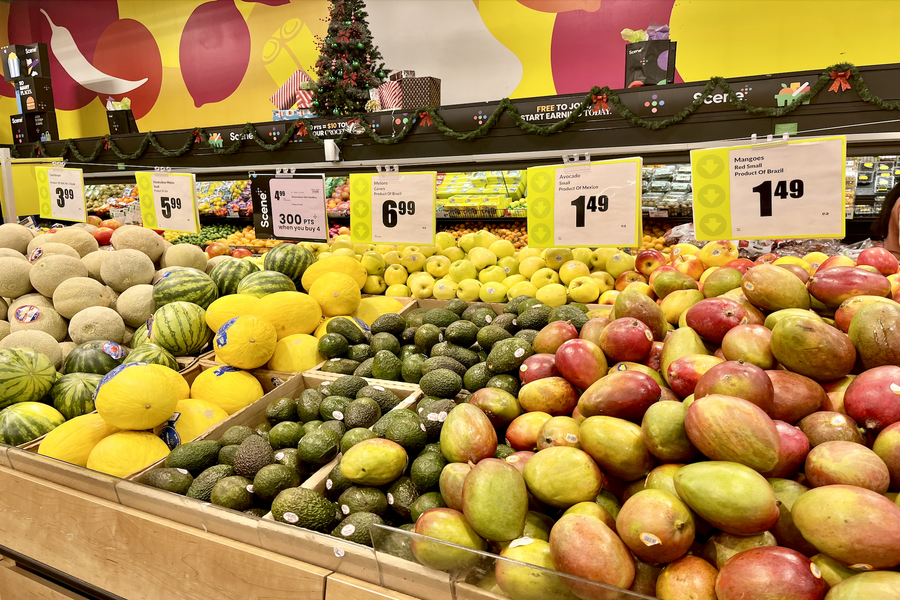
Raised prices in the fruits and vegetable section in a grocery store (Manroop Aulakh)
More Canadians than ever are now relying on food banks to meet essential needs. Food costs and cost of living are key factors in the rise of people in need this year.
The Ipsos poll, which was commissioned by CanadaHelps, says 22 percent of Canadians plan on making use of charitable services.
Laiba Khan, a 21-year-old student, has been going to food banks for two years, now increasing her visits due to high inflation.
In a Zoom meeting, Khan said she uses food banks even though she has food at home as sometimes it is not enough.
“I saw an increase in the price of a lot of food and those are things that I usually need so I realized I couldn’t afford them, and knowing that it’s a necessity I had to go to a food bank,” Khan said.
CanadaHelp said the rising cost of living (74%), and the pandemic (31%) have negatively impacted people’s finances to have access to food banks.
Khan has also been living alone which results in her having no solution but to cut down on food costs.
“Ever since I have been living alone I have been going there, and there’s no way for me to afford my house and food,” Khan said.
According to Hunger Count 2022, there have been 1.5 million visits to food banks in Canada as of March 2022, which is a 15% increase from March 2021
The report looked at more than 4,750 food banks and community organizations, which said the skyrocketing cost of food and housing, as well as high inflation and low social assistance rates, have contributed to the rise in food bank usage.
In a phone interview, Henry Chiu, director of development and marketing at North York Harvest Food Bank also said housing, transportation, and phone plans are a contribution.
“All those things you obviously can’t cheap out on and food is the only flexible expense so when people sort of have an opportunity to cut some costs food is usually the one,” Chiu said.
The report also said that around 500,000 food bank clients — about one-third — are children, and 45.4% are single adult households.
Chiu explains how food banks in general don’t provide enough food because each time the food is supposed to last about three days in a week, which is still not enough
“Essentially in a month, the food is covering 10 days for a household so people that come to food banks still need another way to sustain them and there is enough food to fulfill our service but not enough to fulfill our community members,” Chiu said.
The FoodBanks Canada report suggests long-term and short-term solutions, including creating a universal minimum income floor for lower-income Canadians and providing more affordable and rent-assisted housing.
Chiu also talks about how this is a short-term solution and we really need to address the root causes like affordable housing.
“If you look at any government, whether it’s provincial, municipal, or federal, often what people are talking about are poverty reduction strategies, and affordable housing strategies, and more often than not nothing is ever done and as citizens, we need to address these and other underlying issues,” Chiu said.






Leave a Reply